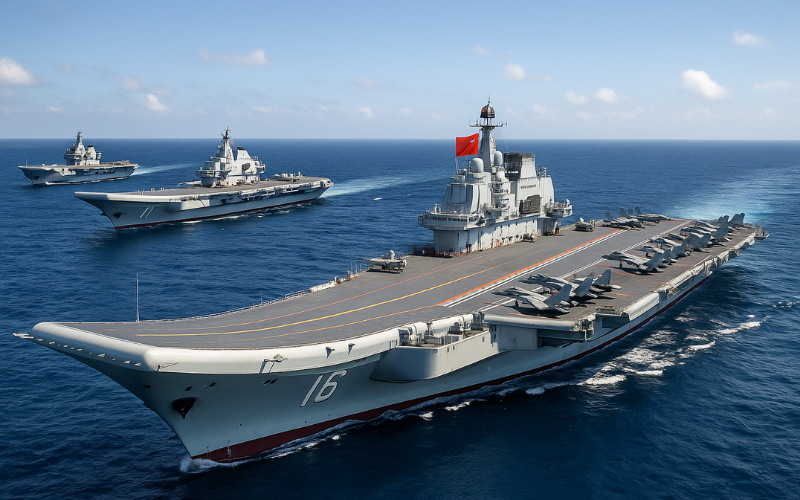
China’s naval ambitions have shifted dramatically over the last two decades. What used to be a regional force focused mostly on coastal defense is now slowly evolving into a blue-water navy — capable of operating carriers, projecting power, and shaping maritime balance across the Indo-Pacific. That change isn’t hypothetical anymore. With its third aircraft carrier recently commissioned, China’s fleet has become one of the most watched developments in global naval dynamics.
Snippet-Ready Definition
China’s growing aircraft carrier fleet refers to China’s rapid expansion from a limited naval force to a modern carrier fleet designed for power projection, regional dominance, and long-term global military influence.
How Many Aircraft Carriers Does China Have Today?
As of late 2025, the People’s Liberation Army Navy (PLAN) officially operates three aircraft carriers.
- The first was Liaoning (Type 001) — a refitted ex-Soviet hull.
- The second is Shandong (Type 002) — China’s first domestically built carrier.
- And now there’s Fujian (Type 003) — the most advanced, indigenously designed carrier commissioned in November 2025.
Just a couple of decades ago, having a single aircraft carrier would have been a major achievement for China. Now, with three — with more reportedly under construction — the pace of change is clear.
The Evolution: Liaoning → Shandong → Fujian
Liaoning: China’s First Step into Carrier Operations
Liaoning marked the first real step for China into carrier operations. Originally a Soviet-era vessel purchased as a hulled hull, it was refurbished, modernized, and recommissioned by PLAN in 2012.
For years, Liaoning served mostly as a training and experimentation platform — exactly what China needed to build experience with deck operations, carrier-based aircraft, and maritime aviation doctrine. Over time, modifications and upgrades allowed it to shift somewhat toward limited operational roles.
In my view, Liaoning’s value lay in giving China breathing room — time to learn, to refine procedures, to build pilot experience — without rushing into high-stakes operations.
Shandong: First Fully Home-Built, But Conservative in Scope
Shandong, launched in 2017 and commissioned in 2019, signaled that China’s shipyards and naval engineers had matured. This was no foreign hull — this was China building from scratch.
However, Shandong remained conservative in design. It used a ski-jump (STOBAR) takeoff system — limiting what types of aircraft and payloads it could launch. Most operations involved carrier fighters and helicopters.
So while Shandong was a significant milestone in indigenous production, it didn’t yet represent a leap in carrier aviation capability. Instead, it strengthened China’s baseline — building, maintaining, operating — from home soil.
Fujian (Type 003): The Game Changer
Then came Fujian. Officially commissioned on November 5, 2025, this is China’s first domestically designed flat-deck carrier, and it uses an electromagnetic catapult-assisted (CATOBAR) launch system.
That’s a big deal. Catapult-assisted launch means Fujian can deploy heavier, more advanced aircraft — including fighters, early-warning planes, and support jets — with full fuel loads and weapon payloads. That dramatically expands what carrier-based aviation means for China.
Quick Comparison/Guide Table
Quick Comparison: China’s Current and Future Aircraft Carriers
| Carrier | Type | Power | Launch System | Main Role | Status |
| Liaoning | Type 001 | Conventional | Ski-jump | Training and limited ops | Active |
| Shandong | Type 002 | Conventional | Ski-jump | Improved operational capability | Active |
| Fujian | Type 003 | Conventional | EMALS/CATOBAR | Advanced naval aviation | Active |
| Type 004 | TBD | Nuclear (expected) | EMALS | Long-range power projection | In development |
| Type 005 | TBD | Unknown | Advanced systems (speculated) | Next-gen capability | Rumored |
Inside Fujian: What Makes It Special
Here’s what stands out about Fujian — and why analysts (myself included) consider it a turning point.
- Design & Technology Leap: Fujian displaces around 80,000 tonnes — significantly larger than Liaoning or Shandong.
- CATOBAR + EMALS Launch System: The electromagnetic catapult system allows powerful, efficient launches. That means heavier aircraft, full fuel and weapon load, and potentially higher sortie rates.
- More Versatile Air Wing Potential: With this setup, Fujian can support a mix of fighters, reconnaissance planes, early-warning aircraft — beyond what ski-jump carriers can handle. As of September 2025, sea trials reportedly included launches of advanced jets like J-35 stealth fighters and support aircraft KJ-600.
On top of that, even though Fujian is conventionally powered (not nuclear), its commissioning signals that China is serious about modern carrier aviation — moving from experimental to operational capability.
What’s Next: Type 004 (and Beyond)
If you think Fujian is impressive, wait till you hear what’s under construction. According to recent imagery and reporting, China has already laid down hull sections for Type 004 aircraft carrier at Jiangnan Shipyard. Unlike Fujian, Type 004 is expected to be nuclear-powered. That would give China far greater endurance and global reach — the kind of capability required for sustained blue-water operations. Some analysts speculate that by the mid-2030s, China could field five to six carriers — a mix of conventional and nuclear — significantly expanding its maritime influence.If that happens, we may see China transition from a regional naval actor to a global maritime contender.
What This Means: Strategy, Power, and Regional Impact
Why should you care about China’s growing aircraft carrier fleet? Because this shift reshapes the strategic landscape across the Indo-Pacific — and possibly beyond.
- Blue-Water Ambitions Realized: With modern carriers, China can protect sea lanes, support overseas interests, and operate far from its coast. This is a major change from the older “near seas defense” stance.
- Influence Over Taiwan, South China Sea & Indian Ocean: A carrier strike group — carrier + escort ships + support vessels — gives China tools for deterrence, power projection, or coercive presence. That affects regional balances and security calculations.
- Naval Modernization & Credibility: Building, launching, and operating sophisticated carriers like Fujian demonstrates China’s growing industrial, technical, and military capacity. It’s not just hype — it’s tangible capability.
- Strategic Competition & Pressure on Neighbours: For countries in the region (or those watching from afar), China’s carrier ambitions add pressure. It may prompt shifts in naval policy, alliances, or defense postures.
From where I sit, the expansion in China’s carrier fleet isn’t just about ships — it’s about influence, deterrence, and long-term strategy.
Limitations & What China Still Needs to Prove
I wouldn’t call China’s carrier fleet a “done deal.” There are real challenges and limitations.
- Limited Operational Experience: Despite having three carriers, China lacks decades of deployment history, joint operations, and sustained global missions that established navies have.
- Range & Endurance Constraints: Fujian and the current carriers are conventionally powered. Without nuclear propulsion, China’s ability to maintain presence far from home — long-term — is still limited.
- Vulnerability in High-Threat Environments: Carriers remain high-value targets. In a conflict situation with submarines, missiles, A2/AD systems, or electronic warfare — carriers could be vulnerable.
- Logistics, Support Ships & Integration Needs: Carriers work only if supported: escort vessels, supply ships, maintenance, crew training, air wings. Building carriers is one thing — sustaining them responsibly is another.
In short — carriers give capability, but they also demand infrastructure, strategy, discipline, and continued investment.
What I’m Watching — Key Signals to Follow
If I were you, and I kept a close eye on Asia-Pacific naval developments, these are the signals I’d watch for in coming years:
- Satellite imagery of new carriers under construction (like Type 004).
- Deployment of newer carrier-capable aircraft — like stealth fighters, early-warning jets, perhaps drones.
- Expansion of China’s naval logistics — replenishment ships, resupply vessels, overseas support infrastructure.
- Frequency and range of carrier deployments — especially operations beyond regional waters.
- Joint exercises with other navies or presence in international waterways — indicating a shift from coastal posture to global presence.
These indicators will tell us whether China is building hardware — or building a sustained, credible naval aviation force.
Conclusion
So here’s my take: China’s carrier program has made remarkable progress. From the refurbished Liaoning to the modern Fujian, it’s clear that China is no longer experimenting — it’s building serious capability.
That said, carriers aren’t magic wands. They bring power, visibility, and deterrence — but also vulnerability, complexity, and heavy logistical demands. China still has to prove it can sustain, operate, and integrate these carriers into a global naval strategy.
For anyone watching Indo-Pacific dynamics — governments, analysts, investors, or simply concerned citizens — China’s growing aircraft carrier fleet matters because it changes strategic math. It doesn’t guarantee dominance. What it does guarantee is that the seas will be watched more closely.
FAQs
Q1: How many aircraft carriers does China currently have?
China currently operates three aircraft carriers: Liaoning, Shandong, and the new Fujian. More carriers, including Type 004, are reportedly in development.
Q2: Why is China expanding its aircraft carrier fleet?
China wants to protect trade routes, project power in the Asia-Pacific, counter rivals like the US, and support regional interests such as Taiwan and the South China Sea.
Q3: Is the Fujian aircraft carrier nuclear-powered?
No. Fujian uses conventional propulsion. China’s next-generation Type 004 carrier is expected to be nuclear-powered.
Q4: Who is China competing with in naval capability?
China’s main competitor is the US Navy, which leads in nuclear-powered carriers, global reach, and combat experience. China is currently closing the gap regionally.
Q5: How many carriers could China have in the future?
Analysts estimate China might operate five to six carriers by 2035–2040, depending on industrial capacity, budget, and strategic priorities.
Disclaimer
This article is based on publicly available information, expert analysis, and open-source intelligence. It is intended for educational purposes only and should not be interpreted as military advice, classified intelligence, or official government policy. Defense capabilities and geopolitical forecasts may change over time.
