Introduction
The thing people love about the Ferrari F40 is that it never tries to be polite. Most modern supercars make you feel comfortable. They assist you, control traction for you and react faster than your brain can. The F40 does the opposite. It asks you to pay attention every second or it will punish your mistakes.
When Ferrari released it the company was celebrating its 40th anniversary. It also became the last road car personally approved by Enzo Ferrari. That detail alone gives the F40 an emotional edge. It marks the end of an era when performance cars were built by people who were obsessed with fast machinery rather than customer reviews or market research.
People who have driven the F40 often describe it as a test of character. It forces you to respect throttle input, braking pressure and road conditions. When everything comes together it creates a level of engagement that modern cars simply cannot match. Not because they are worse but because they are too refined to feel wild.
Snippet-Ready Definition
The Ferrari F40 is a lightweight twin turbo supercar released in 1987 known for its raw performance, 200 mph top speed and iconic design. It remains one of the most legendary Ferraris ever built.
Ferrari F40 1987: Birth Of A Legend
The late 1980s were a time of competition. Porsche was pushing turbo technology and Ferrari wanted to make a statement. The F40 was designed specifically to show that Ferrari could build a road car with the intensity of a racing prototype.
There was no interest in luxury features. The development team was told to focus on performance above everything else. Less weight more power and aerodynamics that looked aggressive because they needed to be. If the car was uncomfortable that was considered a bonus. The target audience was expected to appreciate pain as part of the experience.
People sometimes assume the F40 was designed for millionaires but that is not accurate. It was designed for drivers who wanted something extreme. Money happened to be the entry ticket because Ferrari knew that only a handful of individuals could afford such a specialized machine.
Quick Reference Table Ferrari F40 Specs and Numbers
| Feature | Details |
| Production Years | 1987 to 1992 |
| Engine | 2.9L twin turbo V8 |
| Horsepower | 471 hp |
| Top Speed | 201 mph |
| 0 to 60 mph | Around 4 seconds |
| Weight | About 2400 lbs |
| Units Built | Approx 1315 |
| Current Price | 1.5 to 3 million USD |
From 288 GTO To Ferrari F40
The Ferrari 288 GTO was supposed to go racing in the canceled Group B series. When that opportunity disappeared Ferrari had a choice. End the project or use it as the foundation for something even more insane.
They chose the second option.
Engineers took the core of the GTO and pushed every aspect further.
They went with:
- More horsepower
- Better cooling
- Lower weight
- Bigger turbos
The chassis was strengthened the body became lighter and the entire personality of the car shifted from fast to frightening. The F40 inherited the racing spirit of the GTO but with far fewer compromises.
Ferrari F40 Engine And Performance Specs
The numbers behind the Ferrari F40 still look impressive today even though technology has moved far ahead. The car uses a 2.9 liter twin turbocharged V8 that produces around 471 horsepower and 426 pound feet of torque. Those figures might look mild compared to modern hypercars but in 1987 this was shocking. There were very few street legal cars anywhere near the 200 mile per hour range and the F40 cleared that mark with confidence.
The performance feels even more intense because of its low weight. At around 2400 pounds the F40 is lighter than many modern hatchbacks. Low weight means more acceleration more grip and more drama. It also means the car reacts fast. Sometimes faster than your hands and brain are ready for. That unpredictability is part of its charm and part of its danger.
Ferrari F40 Engine Twin Turbo Behavior
Turbocharged engines in the 1980s were not civilized. There was a big pause while the engine built boost. Nothing happened then suddenly all the power hit at once. The F40 made that behavior even more dramatic. If you pressed the throttle lightly the car hesitated. If you pressed harder it launched forward with a violent surge.
People who drove these cars on track called it a balancing act. Too much power too early and you spun the rear tires. Too little confidence and you never accessed the full potential. The F40 turned every fast corner into a negotiation between courage and physics.
Ferrari F40 Top Speed And Real Driving Experience
Ferrari officially claimed the F40 could hit 201 miles per hour. That made it the fastest production car in the world at launch. What impressed drivers was not the number itself but how raw it felt getting there. The car shook the cabin got hot and the road noise became deafening.
Modern cars isolate you from speed.
The F40 forces you to experience every mile per hour.
People who have driven it flat out often describe the sensation as both terrifying and addictive. Very few cars today offer that combination.
Design And Aerodynamics Built For Speed Not Comfort
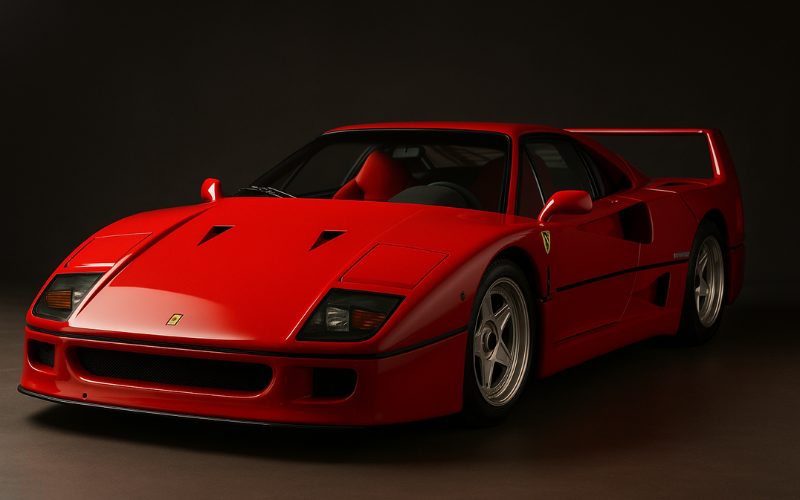
Look at the Ferrari F40 from the side and you can immediately tell that every design decision had a purpose. The front splitter pushes air downward to generate stability. The vents channel air through the radiators to keep the engine cool. The massive wing creates downforce at high speed.
There are no smooth surfaces or polished details. The F40 is shaped like a machine designed to function rather than a sculpture designed to impress dinner guests. That focus shows in the materials too. Much of the body is made from lightweight composites such as carbon fiber and Kevlar. These were exotic materials at the time and few manufacturers were willing to use them on road cars.
Lightweight Engineering Handling With Teeth
Because the F40 is so light and stiff it has a direct reactive feel that few modern cars can replicate. The suspension is firm the steering is quick and the brakes are big enough to make passengers nervous.
Driving it fast is not effortless. You need skill and concentration. The car responds instantly to throttle steering and braking inputs. If you hesitate it bites. If you overcommit it also bites. It demands confidence and experience. When everything clicks the result is unforgettable.
Ferrari F40 Interior Purpose Built And Brutally Simple
Inside the F40 there is nothing to distract you from driving. The seats are thin and firm. The dashboard is bare aluminum and carbon. The floor is uncovered. Even the door panels are simple sheets with pull cords instead of handles.
People sometimes laugh when they see the interior because it looks unfinished but that was intentional. Removing weight mattered more than looking comfortable. Ferrari expected owners to focus on driving not convenience.
The simplicity also adds to the drama. When you sit in the F40 you feel exposed. You can hear the turbos spin the gears whine and the chassis buzz. It is raw mechanical feedback without filters.
Is The Ferrari F40 Practical To Live With
If you want a pleasant daily driver this is not the right car. The cabin is loud hot and cramped. It is not easy to climb in or out. The clutch is heavy and the fuel economy is terrible. There is minimal luggage space and even less patience for traffic.
But here is the secret. Nobody buys an F40 for comfort. They buy it because it delivers an intense experience every time you drive it. A casual cruise becomes exciting. A highway run becomes memorable. Even starting the engine feels theatrical.
Owning an F40 is a commitment. But if you enjoy intense driving you will find the discomfort worth it.
Driving Experience What Experts And Owners Say
People who have driven the Ferrari F40 usually describe it with the same word. Respect. It demands it. The steering feels heavy at low speeds but transforms at higher speeds into something sharp and precise. The gear shift has a satisfying mechanical feel that requires deliberate movement.
When the boost kicks in the car changes personality. It goes from loud to aggressive in a heartbeat. You feel the front go light and the rear push hard. It is dramatic thrilling and sometimes intimidating.
The F40 does not make things easy. You earn every fast lap every clean corner and every controlled slide. This is why drivers love it. It rewards skill rather than software.
Ferrari F40 Versus Modern Supercars
Modern Ferraris are easier to drive fast because they use computers to prevent mistakes. Electronic stability systems correct errors before the driver even notices. This creates extremely high speed but less drama.
The F40 does not save you.
If you lose grip you deal with consequences.
This is why enthusiasts call it more honest. It forces you to pay attention. When you get it right the feeling is pure satisfaction.
Ferrari F40 Price Today What It Costs To Own One
When new the Ferrari F40 was extremely expensive. Today it is far beyond that. Depending on condition originality and history values typically range between 1.5 million and 3 million dollars.
The price is not driven by luxury or practicality. It is driven by emotion rarity and historical significance. People do not view the F40 as a car. They view it as art technology and heritage.
Ferrari F40 For Sale What Buyers Will Actually Find
Finding an F40 for sale is difficult because most owners hold on to them. When one appears it is usually a low mileage car with extensive documentation and careful maintenance.
Original examples with no modifications command the highest prices. Cars with repaint engine swaps or aftermarket parts can lose massive value.
Certification from Ferrari adds premium value because it verifies history and originality. For a collector that certificate is worth more than horsepower.
Buying A Ferrari F40 Expert Tips And Costs
If someone is serious about purchasing a Ferrari F40 they need patience preparation and expert help. These cars are too valuable to evaluate casually.
Inspection Checklist What To Look For
Important items include:
- Accident history
- Matching engine and chassis numbers
- Body repairs and repaint
- Turbo wear
- Chassis cracks
- Suspension damage
- Complete service records
A neglected F40 can cost enormous money to restore. Buyers should always hire specialists familiar with classic Ferraris.
Maintenance And Running Costs
Owning an F40 costs more than most exotic cars because parts are rare and labor is specialized.
Typical expenses include:
- Annual maintenance 8000 to 12000 dollars
- Tires around 5000 dollars per set
- Clutch replacement around 15000 dollars
Fuel and insurance costs can also be high depending on use.
People who own F40s rarely complain. They expect high expenses because they value the experience.
Special Variants F40 LM Competizione And Track History
Ferrari built a limited number of high performance versions for racing. These variants had more power less weight improved brakes and aerodynamic upgrades. They raced in GT competitions and endurance events worldwide.
Track versions were not only faster. They were sharper and even more aggressive. Today they are extremely rare and valued higher than standard F40 models because of their motorsport history.
Ferrari F40 Versus Ferrari F50 How They Compare
People often compare the F40 and F50 because they belong to the same lineage of special Ferrari models. They share similar goals but very different personalities.
The F40 uses a turbocharged V8 with sudden explosive power. The F50 uses a naturally aspirated V12 derived from Formula 1 technology. The F40 is violent and unpredictable. The F50 is smoother louder and more refined.
Value And Rarity
Ferrari built roughly 1300 F40s and only 349 F50s. The F50 is much rarer but rarity does not guarantee higher value. Many collectors still prefer the F40 because it represents the last model associated with Enzo Ferrari.
Ferrari F40 In Pop Culture
For many people the Ferrari F40 was the car from posters video games and trading cards. It defined what a dream car looked like during the 1990s. Its sharp design bright red color and oversized wing made it instantly recognizable.
The F40 became a cultural symbol of speed and freedom rather than a technical object. It was the car children imagined driving when they grew up.
Ferrari F40 Lego And Collectibles
Over the years the F40 has been recreated in countless scale models and building sets. These products help new generations discover the car even if they never see one in person. Collectibles keep the F40 relevant and visible in modern culture.
Ferrari F40 Drawing And Design Culture
Artists enjoy drawing the F40 because its lines are angular sharp and full of character. The shape translates well into art tattoos posters and digital renderings. The car photographs well too which is why it is popular among photographers and designers.
Conclusion
Some supercars are admired while others are feared and respected. The Ferrari F40 belongs in the second category. It is not comfortable quiet or user friendly. It demands patience skill and attention. It makes you work for every mile and every moment.
This difficulty is exactly what makes it memorable. It delivers an experience that modern supercars often avoid. Drivers today are used to cars that protect them from mistakes. The F40 expects you to avoid mistakes on your own.
Even decades after its release the F40 remains a benchmark of pure driving. It represents a time when engineers built cars focused on speed rather than convenience. It is a reminder that risk and excitement can coexist.
FAQs
Q1: How fast is the Ferrari F40?
The Ferrari F40 can reach around 201 mph making it one of the fastest production cars of its time.
Q2: How much is a Ferrari F40 worth today?
Prices usually range between 1.5 and 3 million dollars depending on originality condition and mileage.
Q3: How many Ferrari F40s were made?
Around 1315 units were built including a few special race variants.
Q4: What engine does the Ferrari F40 have?
It uses a 2.9 liter twin turbocharged V8 producing about 471 horsepower.
Q5: Why is the Ferrari F40 so famous?
It combines extreme performance a raw driving experience lightweight construction and historical significance as Enzo Ferrari’s final car.
Disclaimer
This article is for educational and informational purposes only. All price ranges performance figures and technical details are based on available public data and may vary by model condition or market. We are not offering financial mechanical or purchasing advice.
